
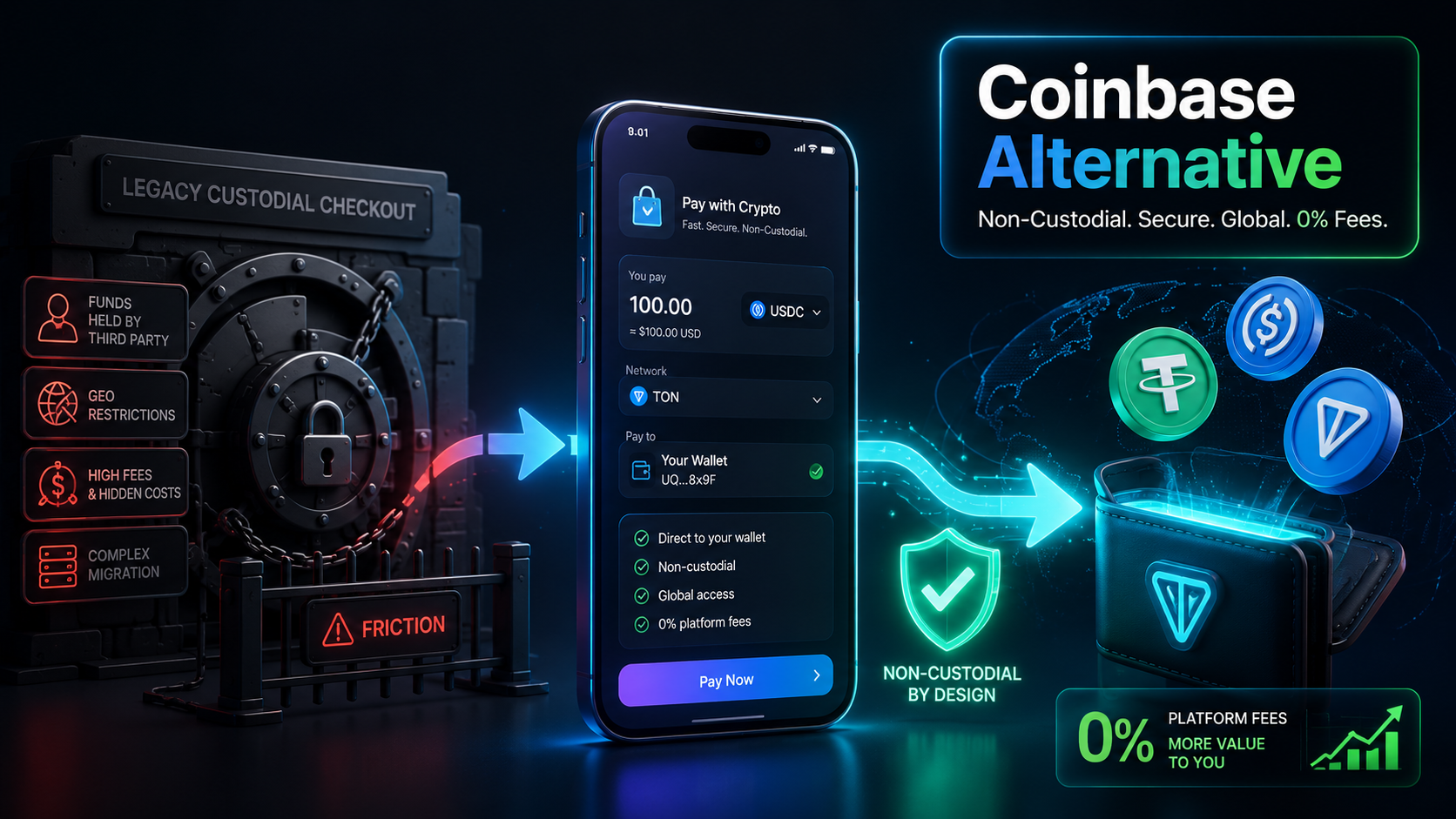
The sudden deprecation of the legacy Coinbase Commerce portal on March 31, 2026, left thousands of digital businesses, SaaS founders, and global merchants stranded. While the company has directed users to its new Coinbase Business product, the migration has introduced severe friction: a complete shift from non-custodial to custodial fund management, strict geographic lockouts for anyone outside the US and Singapore, and a controversial transition flow that triggered major security alerts across the crypto community.
If your company relies on receiving global customer payments without intermediaries, finding a secure, developer-first Coinbase Commerce alternative is no longer optional—it is a critical business continuity requirement.
By transitioning to a modern non-custodial crypto payment gateway like recv, you can bypass geographical blocks, maintain absolute ownership of your private keys, and eliminate turnover fees entirely. This guide walks you through what went wrong with the Coinbase migration and details a safe, ten-minute step-by-step path to restore your checkout flow.
What Happened to Coinbase Commerce?
For years, Coinbase Commerce served as a popular option for self-custodial crypto acceptance. However, as the cryptocurrency landscape shifted, Coinbase chose to retire its merchant-controlled architecture. The merchant portal was permanently shut down on March 31, 2026, disabling legacy API checkouts and locking out dashboard access.
In its place, Coinbase launched Coinbase Business. While the platform offers fiat off-ramps and accounting integrations, it represents a complete departure from the features that merchants originally valued:
- Mandatory Custody: Legacy Coinbase Commerce was self-custodial. Coinbase Business is entirely custodial—meaning Coinbase holds your funds, controls your balances, and acts as an intermediary.
- Geographic Exclusion: Coinbase Business is strictly limited to companies registered in the United States or Singapore. International merchants registered in Europe, Latin America, Asia, or the UK have been left with zero migration paths and were abruptly disconnected.
- The Seed Phrase Security Warning: During the sunset rush, security analysts and independent investigators flagged a massive vulnerability in the official transition tool. To retrieve legacy funds, Coinbase's migration flow prompted users to input their 12-word seed phrases directly into a web browser form. This approach goes against fundamental web3 security rules and was heavily criticized by prominent security researchers for exposing merchants to phishing risks.
For businesses that refuse to compromise on security, want to keep their assets in their own wallets, or operate outside the US/Singapore corridor, a modern alternative is required.
Why a Non-Custodial Setup is Crucial for Your Business
Custodial gateways hold your revenue on their books. This model introduces counterparty risk, potential fund freezes, and invasive KYC checks that slow down operations.
When evaluating a Coinbase Commerce alternative, maintaining a non-custodial infrastructure should be your top priority. Under a true non-custodial system, your private keys never leave your device. Payments go directly from the buyer’s wallet to your wallet, bypassing intermediaries entirely.
To achieve this without the headache of running self-hosted node clusters, you need a smart payment monitor. This is exactly why recv was built.
Rather than managing your funds or generating endless, fragile deposit addresses, recv acts as a real-time blockchain watcher. When a customer initiates a transaction, recv generates a secure, QR-native Smart Checkout invoice and monitors the target blockchain for the corresponding transaction hash, amount, and time window. Once verified, it dispatches an HMAC-SHA256 signed webhook directly to your server to instantly unlock the digital product or SaaS subscription. Your money never touches recv's wallets, meaning zero custody risk and zero potential for account freezes.
Comparing the Options: Coinbase vs. recv
Before looking at the technical integration, it is helpful to see how the service structures compare side-by-side:
| Feature | Coinbase Commerce (Legacy) | Coinbase Business (New) | recv |
|---|---|---|---|
| Custody Model | Self-Custodial | Custodial | Non-Custodial (Direct-to-Wallet) |
| Turnover Fees | 1% transaction fee | Variable / High | 0% Turnover Fees |
| KYC Restrictions | Late-stage KYC mandated | Full corporate KYC required | No KYC required for merchants |
| Supported Regions | Global | US & Singapore only | Global (No regional restrictions) |
| Supported Networks | Base, EVM, Solana | Selected custodial networks | TON, TRON (TRC-20), Base, BSC |
| Pricing Setup | Pay-per-transaction | Pay-per-transaction + Account fees | Simple flat subscriptions ($0 to $79/mo) |
| Seed Phrase Request | No | Yes (during legacy migration) | Never (You only provide public addresses) |
Why recv is the Ideal Alternative for High-Growth Merchants
For online shop owners, indie hackers, and SaaS developers, recv is designed to replace legacy payment architectures with a faster, cheaper, and more flexible system.
1. Direct-to-Wallet Settlements
With recv, funds settle instantly to your own wallets. Supported networks include TON, TRON (TRC-20 USDT), Base (the Coinbase L2 EVM network, ensuring you keep your existing Base flows), and BSC. You can accept stablecoins and major native assets like USDT, USDC, TON, SOL, and BNB directly into self-custodial wallets like Tonkeeper, Phantom, or MetaMask.
2. 0% Turnover Fees
Traditional processors take a percentage of every sale. With recv, you keep 100% of your earnings. Instead of a transaction tax, you pay a predictable, flat subscription model based on your usage scale:
- Trial Plan: $0/month (fully featured, capped at 15 live invoices)
- Merchant Plan: $9/month (unlimited transaction volume)
- Developer Plan: $29/month (unlimited volume + developer integrations)
- Business Plan: $79/month (unlimited volume + enterprise-grade support)
3. Developer-First Tools & AI Integrations
Built with modern engineering in mind, recv features a unified checkout API, reliable webhook delivery with exponential backoff, and a dedicated Model Context Protocol (MCP) server. This allows AI coding agents like Claude or Cursor to programmatically generate invoices, verify transaction logs, and write secure integrations on your behalf.
4. Smart Checkout UX
Your customers get a seamless, mobile-optimized checkout interface via deep links like https://recv.money/app/checkout/{id}. This screen auto-detects installed crypto wallets (such as Tonkeeper or Phantom), provides QR-native payment flows, and includes intelligent resolution of minor underpayments to prevent stuck transactions.
Migration Guide: From Coinbase Commerce to recv in 10 Minutes
Migrating your payment infrastructure is straightforward. Because recv is non-custodial, you never have to share or import recovery phrases. Follow these four steps to get back up and running.
Step 1: Secure Your Public Wallet Addresses
Collect the public receiving addresses for the networks you want to accept. For example:
- Your TRON address (for TRC-20 USDT payments)
- Your TON address (for TON and TON_USDT payments)
- Your Base / BSC EVM address (for USDC, USDT, and BNB payments)
Never share your private keys or seed phrases during this or any setup step.
Step 2: Configure Your recv Account
- Go to the recv dashboard or use the convenient Telegram management bot.
- Under your account settings, input your public wallet addresses.
- Select your pricing plan. If you are testing the waters, the Trial Plan ($0/mo) is a great place to start.
Step 3: Implement the Invoice Creation API
Replace your old Coinbase Commerce API endpoints with the unified recv invoice generation flow. To see how simple this is, check the developer API documentation.
Here is a typical payload to create a payment request:
curl -X POST https://api.recv.money/v1/invoices \
  -H "Authorization: Bearer YOUR_API_KEY" \
  -H "Content-Type: application/json" \
  -d '{
    "amount": "29.00",
    "currency": "USDT",
    "network": "TRON",
    "order_id": "order_10492",
    "redirect_url": "https://yoursite.com/success",
    "webhook_url": "https://yoursite.com/api/webhooks/recv"
  }'
This request returns a structured JSON payload containing your unique checkout link: https://recv.money/app/checkout/inv_abc123.
Step 4: Verify Incoming Signed Webhooks
To secure your backend, recv signs every webhook payload with a SHA256 HMAC signature using your endpoint's unique webhook secret.
Below is a ready-to-run Node.js express template to verify incoming payment notifications:
import crypto from 'crypto';
import express from 'express';

const app = express();
app.use(express.json());

// Set your webhook secret from the recv dashboard
const RECV_WEBHOOK_SECRET = process.env.RECV_WEBHOOK_SECRET || 'your_recv_secret';

app.post('/api/webhooks/recv', (req, res) => {
  const signature = req.headers['x-recv-signature'] as string;
  const rawPayload = JSON.stringify(req.body);

  if (!signature) {
    return res.status(401).send('Missing signature header');
  }

  // Calculate HMAC-SHA256 signature to prevent spoofing
  const expectedSignature = crypto
    .createHmac('sha256', RECV_WEBHOOK_SECRET)
    .update(rawPayload)
    .digest('hex');

  if (signature !== expectedSignature) {
    console.error('Webhook signature mismatch!');
    return res.status(400).send('Invalid webhook signature');
  }

  const { status, order_id, amount, currency, network } = req.body;

  if (status === 'paid') {
    // Process your order delivery securely here
    console.log(`Payment confirmed: Order ${order_id} received ${amount} ${currency} on ${network}`);
  }

  // Always return a 200 OK to acknowledge delivery
  res.status(200).send('Webhook processed successfully');
});

app.listen(3000, () => console.log('Payment webhook listener running on port 3000'));
FAQ
What happened to legacy Coinbase Commerce accounts?
The legacy merchant portal closed permanently on March 31, 2026. Merchants who did not withdraw their assets or transition their custom integrations prior to this date can no longer collect payments or view historical ledger data through the dashboard.
Is my seed phrase safe if I used Coinbase’s transition tools?
Several security firms and independent web3 researchers warned against using Coinbase's migration page due to prompts requiring merchants to type their 12-word seed phrases into a browser form. If you have entered your seed phrase online, it is highly recommended to move your remaining funds to a newly generated wallet as a safety precaution. When setting up recv, you only share your public receiving address—your private keys remain offline and completely untouched.
Does recv hold my business revenue?
No. Because recv operates as a non-custodial blockchain monitor, it does not process, hold, or route your actual crypto funds. All assets are transferred directly from the customer’s wallet to your personal, self-custodial wallet address.
Can I accept payments on Base using recv?
Yes. Despite transitioning away from Coinbase's closed ecosystem, you can still accept USDC and USDT on Base natively using recv. This allows you to leverage fast transaction speeds and low fees on the Base L2 network while avoiding Coinbase's custodial account restrictions.
Switch to a Fee-Free, Non-Custodial Workflow Today
Do not let centralized platform sunsets or strict geographic blocks disrupt your digital business. With recv, you regain complete control over your cash flow, access international customers without KYC barriers, and enjoy a flat subscription model with 0% transaction fees.
To start accepting crypto directly to your wallet in minutes, set up your trial account on the recv homepage or explore our developer resources via our developer API documentation.