
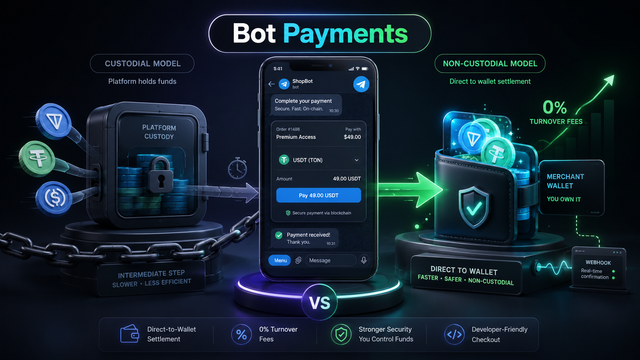
Monetizing a Telegram bot requires a reliable payment system that handles transactions quickly, safely, and with minimal friction. When comparing Cryptomus vs recv, you are looking at two fundamentally different architectural paths: a custodial processor and a non-custodial transaction monitor. Selecting the right model depends on your business volume, security requirements, and how much control you want to keep over your funds.
This guide provides an objective comparison of their fee structures, technical architectures, user experience (UX) inside Telegram, and API capabilities to help you decide which tool fits your bot best.
The Core Architectural Difference: Custodial vs. Non-Custodial
The most important distinction between Cryptomus and the gateway built by recv is where your customer’s funds go immediately after payment.
How Cryptomus Works (The Processor Model)
Cryptomus is a custodial cryptocurrency payment processor. When a customer pays your Telegram bot, the funds are deposited into a wallet controlled by Cryptomus.
- The customer sends crypto to a temporary address generated by the processor.
- The processor detects the transaction and updates your internal merchant balance.
- The funds remain on the platform until you request a manual or automated withdrawal to your external wallet.
- Each withdrawal is subject to a network gas fee and, in some cases, additional platform payout commissions.
How recv Works (The Direct-to-Wallet Model)
Operating as a non-custodial payment gateway and transaction monitor, recv never takes custody of your funds. The infrastructure is built around direct-to-wallet settlements:
- The system generates a checkout invoice with a unique tracking identifier (using amount, memo, time window, or transaction hash matching).
- The customer pays directly to your own wallet address (e.g., your Tonkeeper, Trust Wallet, or safe multi-sig ledger).
- A real-time blockchain watcher monitors the network to identify the incoming transfer.
- Once detected, the system immediately issues an HMAC-SHA256 signed webhook to your Telegram bot’s backend, allowing you to instantly deliver the digital product or access.
Because private keys never leave your device and no intermediate wallets are used, your funds are secure from platform-level hacks, liquidity issues, or unexpected custodial account freezes.
The Economics of Fees: Turnover Commission vs. Flat Subscription
Payment processing fees can quickly erode the profit margins of growing digital products and paid Telegram communities. The pricing models of Cryptomus vs recv reflect their contrasting architectures.
Cryptomus Fees
Cryptomus charges a percentage fee on every incoming transaction.
- Turnover Fees: Fees typically start at 2.0% for new merchants and can scale down to 0.4% only if your project processes exceptionally high monthly volumes.
- Withdrawal Fees: When you transfer your earnings from the platform to your personal cold storage or exchange wallet, you pay standard blockchain gas fees plus potential network-specific overhead.
recv Fees
To support developers and indie creators, recv charges 0% turnover fees on all plans. Instead of taxing your success, the platform operates on a predictable flat subscription model:
- Trial Plan: $0/mo (Free forever, capped at 15 live invoices at any given time).
- Merchant Plan: $9/mo (Unlimited transaction volume, ideal for standard bots).
- Developer Plan: $29/mo (Advanced features, expanded invoice limits).
- Business Plan: $79/mo (Dedicated support, maximum limits for high-scale applications).
Calculating the True Cost (Comparison Scenario)
Let's analyze how much a Telegram bot owner pays under both models across different monthly sales volumes:
| Monthly Sales Volume | Cryptomus (Estimated 1.5% Fee) | recv (Merchant Plan: $9/mo) | Monthly Savings with recv |
|---|---|---|---|
| $1,000 | $15.00 | $9.00 | $6.00 |
| $5,000 | $75.00 | $9.00 | $66.00 |
| $10,000 | $150.00 | $9.00 | $141.00 |
| $50,000 | $750.00 | $9.00 (or $29/mo Developer) | $721.00 - $741.00 |
If your Telegram bot scales, paying a percentage of your turnover acts as a tax on growth. Choosing a flat subscription ensures your infrastructure costs remain predictable and minimal.
KYC Requirements and Account Safety
Regulatory compliance and access restrictions are crucial factors for developers setting up automated billing systems.
- Cryptomus: As a centralized custodial platform, Cryptomus operates under regulatory frameworks that require Know Your Customer (KYC) identity verification for higher transaction tiers, specific regions, or during automated fraud alerts. If a transaction triggers risk assessment algorithms, your merchant balance can be temporarily frozen until compliance documentation is reviewed.
- recv: Because the gateway does not hold, move, or store merchant funds, no KYC is required to use the service. You connect your public wallet address, and transactions settle directly onto the ledger.
Legal Disclaimer: Please note that while non-custodial gateways do not enforce platform-level KYC, they do not exempt merchants from their local tax and regulatory obligations.
Supported Networks and Assets
The ideal payment gateway must align with the specific chains your target audience uses inside Telegram.
Supported Networks:
┌──────────────────────────────────────────────┐
│  TON  │ TON_USDT │ TRON (TRC-20) │ Base │ BSC │
└──────────────────────────────────────────────┘
Supported Assets:
┌──────────────────────────────────────────────┐
│     USDT  │  USDC  │  TON  │  SOL  │  BNB    │
└──────────────────────────────────────────────┘
Cryptomus supports a wider selection of assets, including legacy networks like Bitcoin (BTC) and Ethereum (ERC-20) mainnet. However, processing payments on these networks inside Telegram is often impractical for microtransactions due to high network gas fees.
To keep checkout times fast and transaction costs low, recv focuses on the networks most popular for mobile payments:
- TON & TON_USDT: The native choices for Telegram users, allowing frictionless payments directly inside Web Apps.
- TRON (TRC-20 USDT): The global standard for stablecoin transfers.
- Base & BSC: Low-cost Layer 2 and EVM options for active Web3 users.
- Supported Assets: USDT, USDC, TON, SOL, and BNB.
Telegram Checkout UX and Integration
In-app conversion rates depend heavily on reducing checkout steps. If a user has to copy an address, open an external wallet, input the exact decimal amount, and switch back, they might abandon the purchase.
Smart Checkout Features
With the Smart Checkout system designed by recv, the user experience is fully optimized for Telegram:
- Deep Linking: Generates payment buttons that deep-link directly into mobile wallets like Tonkeeper, Phantom, or Trust Wallet. The user clicks "Pay", their wallet opens automatically with the pre-filled invoice, and they sign the transaction with a single tap.
- Intelligent Underpayment Resolution: If a customer accidentally sends slightly less than the invoice amount due to exchange rate changes or gas deductions, the system dynamically calculates the remaining balance or resolves the invoice based on customizable tolerance settings, reducing manual support tickets.
- Telegram Management Bot: You can monitor invoices, track active subscriptions, and view real-time gateway statistics directly inside Telegram using the platform's native bot.
Developer Experience: HMAC-SHA256 vs. MD5 Webhooks
A reliable backend integration ensures your bot delivers purchases immediately. If a checkout system fails to send a webhook, your customer is left waiting, leading to complaints.
Cryptomus secures its callback webhooks using an older signature method: an MD5 hash generated from the base64-encoded body combined with your API key.
In contrast, recv secures webhooks using industry-standard HMAC-SHA256 signatures. This ensures the payload cannot be intercepted or tampered with. Additionally, the system provides guaranteed webhook delivery with exponential backoff, retrying automatically if your server experiences temporary downtime.
For developers building high-performance systems, recv provides an MCP (Model Context Protocol) server. This allows AI assistants like Claude or Cursor to write code, create payment invoices, verify webhook integrations, and check transaction statuses on your behalf.
Node.js Integration Example: Verifying recv Webhooks
Here is how you can securely verify an incoming webhook from the platform in a TypeScript or Node.js environment:
import crypto from 'crypto';

/**
 * Verifies the HMAC-SHA256 signature of an incoming recv webhook.
 * @param rawBody - The raw JSON string payload received from the webhook.
 * @param signature - The signature header (usually sent as 'x-recv-signature').
 * @param secret - Your merchant webhook secret key.
 */
function verifyWebhookSignature(
  rawBody: string,
  signature: string,
  secret: string
): boolean {
  if (!signature || !secret) {
    return false;
  }

  // Create an HMAC-SHA256 hash using your secret
  const hmac = crypto.createHmac('sha256', secret);
  hmac.update(rawBody);
  const calculatedSignature = hmac.digest('hex');

  // Compare using timingSafeEqual to protect against timing attacks
  try {
    return crypto.timingSafeEqual(
      Buffer.from(signature, 'utf8'),
      Buffer.from(calculatedSignature, 'utf8')
    );
  } catch (err) {
    return false;
  }
}
Cryptomus vs recv: Comparison Table
| Feature | Cryptomus | recv |
|---|---|---|
| Custody Type | Custodial (Funds held on platform) | Non-Custodial (Direct-to-wallet) |
| Transaction Fee | 0.4% to 2.0% per transaction | 0% turnover fees (All plans) |
| Pricing Model | Percentage commission | Flat monthly subscription |
| KYC Required | Yes (Tiered / Risk-based) | No KYC |
| Payout Process | Manual or automated withdrawal request | Instant settlement directly into your wallet |
| Supported Networks | TRON, Ethereum, Bitcoin, BSC, etc. | TON, TRON, Base, BSC |
| Supported Assets | 100+ tokens | USDT, USDC, TON, SOL, BNB |
| Webhook Security | MD5 hash (body + API key) | HMAC-SHA256 signature |
| Developer Tools | Standard APIs, basic SDKs | Unified API, MCP server for AI integration |
| UX Highlights | Standard payment links | Smart Checkout, mobile deep links, QR-native |
When to Choose Which?
Choose Cryptomus if:
- You need to support a vast array of alternative assets (like BTC or Dogecoin) directly on the payment screen.
- You require automated in-platform token conversions (e.g., auto-swapping incoming TRX to stablecoins before withdrawal).
- You need built-in fiat card purchases or P2P trading features directly inside your checkout dashboard.
Choose recv if:
- You want to pay zero percentage fees on your transactions and keep 100% of your revenue.
- You want immediate direct-to-wallet settlement, removing the risk of platform freezes, delays, or withdrawal costs.
- You run a legitimate digital business, Telegram bot, or SaaS tool and want to bypass unnecessary KYC friction.
- You want an optimized checkout experience inside Telegram using deep-links directly into Tonkeeper or Phantom.
- You prefer integrating with modern developer tools like HMAC-SHA256 signed webhooks and AI-ready MCP servers.
FAQ
What are the main differences between Cryptomus vs recv?
The core difference lies in custody and fees. Cryptomus is a custodial platform that takes your funds, stores them, and charges a percentage fee on every transaction. In contrast, recv is a non-custodial transaction monitor that charges a flat subscription fee, allows funds to flow directly into your private wallet, and takes 0% commission on transactions.
Does recv charge any commissions on payments?
No. There are 0% turnover fees on all subscription plans. Whether you receive $1,000 or $100,000 per month, you only pay a flat monthly subscription.
Do I need KYC to accept USDT with recv?
No. Because the platform never holds your funds, you do not need to undergo identity verification (KYC) to start accepting crypto. You simply configure your personal wallet addresses.
What happens if a customer sends the wrong amount?
The Smart Checkout system built by recv features an underpayment resolution mechanism. Based on your settings, it can handle minor balance discrepancies automatically or guide the customer to pay the exact remaining balance to complete their order.
Ready to scale your Telegram bot payments? Explore how our main website and business-focused payment scaling solutions can help you keep 100% of your earnings with secure, direct-to-wallet payments.